close
Choose Your Site
Global
Social Media
Views: 0 Author: Site Editor Publish Time: 2026-07-13 Origin: Site


Global markets are rapidly shifting toward sustainable packaging solutions. This transition places massive operational pressure on manufacturers. You must scale up paper bag production quickly to meet rising brand demands. Understanding how a paper bag machine works is no longer merely a technical exercise. It represents a mandatory step for procurement and operations teams. You need this knowledge to accurately assess production capabilities. Buyers must identify potential bottlenecks and mechanical limitations before committing to an investment.
We will move beyond basic mechanics in this guide. We demystify the core production phases and key component reliability. You will discover the exact evaluation criteria necessary for shortlisting commercial-grade machinery. By analyzing these operational realities, you can confidently select equipment matching your facility’s unique output targets.
A modern paper bag machine operates through a sequential, synchronized process: web feeding, tube forming, gluing, cutting, and bottom folding.
Component quality—specifically servo motors, web tension controllers, and precision gluing units—directly dictates machine uptime, waste reduction, and output consistency.
Upgrading to a fully automatic paper bag making machine drastically reduces labor costs but requires rigorous assessment of format changeover times and maintenance protocols.
Evaluating a machine requires balancing advertised speeds against your facility’s specific paper grammage (GSM), required bag dimensions, and handle-attachment needs.
Table of Contents
Modern paper bag manufacturing relies on a synchronized sequence of mechanical events. Each phase must operate in perfect harmony. A failure in one stage instantly compromises the final product. We break down these core phases below.

Production begins at the unwinding stand. Operators load massive rolls of raw kraft paper onto a pneumatic shaft. The machine unwinds this paper into a continuous flat sheet called a web. Maintaining consistent tension across this web is critical. If tension drops, the paper wrinkles. If tension spikes, the paper snaps.
Decision Lens: You must evaluate the web guide systems. Top-tier machines utilize automated Edge Position Control (EPC) or Line Position Control (LPC). These electronic sensors continuously monitor the paper's edge. They signal electric actuators to shift the roll left or right in milliseconds. This automation prevents paper snapping and dramatically reduces material waste during high-speed runs.
The flat web travels into the forming section. Here, specialized forming plates fold the paper into a continuous tube. The machine overlaps the two edges. Simultaneously, an extrusion nozzle applies a narrow bead of adhesive along this seam. Compression rollers then press the seam together to secure the bond.
Decision Lens: You must assess the glue application methodology. Cold glue systems are economical and penetrate kraft paper fibers well, but they require longer drying times. Hot melt adhesive systems cure almost instantly. Hot melt provides superior bag integrity under heavy loads. Choosing the right system depends entirely on your target bag strength and production speed.
The glued, continuous tube moves into the cutting matrix. A heavy-duty rotary blade mechanism sections the tube into individual lengths. The blade must strike cleanly to prevent jagged edges. The speed of the rotating blade dictates the final length of the bag.
Decision Lens: Cutting printed paper introduces a new challenge. You cannot rely on timing alone. The machine must utilize high-precision color-mark sensors, known as photocells. These sensors read tiny registration marks printed on the paper web. They instantly adjust the cutting blade's timing. This ensures the cut aligns perfectly with brand graphics, preventing skewed logos.
The cut tubes transfer to the bottoming section. Mechanical clamps open one end of the tube. Complex folding fingers create the bottom geometry. For grocery bags, this is typically a simple V-bottom. For retail shopping bags, this requires a complex block-bottom or square-bottom fold. The machine applies a final layer of adhesive and presses the bottom shut.
Decision Lens: Bottom folding represents the highest-failure point in cheap machines. Subpar mechanical linkages struggle with thick paper folds. You need robust bottom-folding mechanics. Heavy-duty cams and precise folding fingers are critical for structural compliance. Without them, bags suffer from bottom leaks and blowouts.

Equipment lifespan depends heavily on internal engineering. A machine might look robust on the outside, but its internal components dictate daily uptime. You must inspect three crucial subsystems.
Function: These electronic systems drive the precise synchronization of all moving parts. The PLC acts as the brain. The servo motors act as the muscles, responding to digital commands in real-time.
Commercial Impact: Older machines rely on mechanical gears and chains. These wear out, stretch, and require constant lubrication. Transitioning to servo-driven systems reduces maintenance downtime drastically. Servo motors lower machine vibration and allow for precise digital adjustments on the fly. This eliminates mechanical slop and improves yield.
Function: These units pump adhesive from holding tanks to the application nozzles. They must apply adhesive evenly without overspray.
Commercial Impact: Open-pot glue systems expose adhesive to the air. The glue thickens, crusts, and creates blockages. You should look for fully enclosed gluing systems. Enclosed systems prevent adhesive drying. They minimize daily cleaning labor and ensure consistent application regardless of operator skill. Consistent glue lines mean fewer rejected bags.
Function: The HMI provides a centralized control screen for operators. It displays machine speed, bag counts, and operating temperatures.
Commercial Impact: Evaluators should look for highly intuitive interfaces. A premium HMI supports rapid format changeovers by saving "recipes" for different bag sizes. It also provides real-time fault diagnostics. If a web breaks, the HMI instantly highlights the exact location on screen. This accelerates troubleshooting and maintains high production data logging standards.
Choosing the correct automation level determines your long-term profitability. You must align the machine's capabilities with your specific market demands.
Semi-automatic machines handle web feeding, tube forming, and cutting. However, they often require operators to manually finish certain steps. Workers might need to fold and glue the bottoms manually. They might also need to paste handles by hand.
These systems are best suited for short runs or highly bespoke sizes. They fit well within facilities operating on lower capital expenditure budgets. However, you face a distinct risk factor. A higher reliance on manual labor introduces significant variability. Output quality fluctuates based on operator fatigue. Labor costs scale linearly with production volume.
A fully automatic paper bag machine offers a continuous flow from raw roll to finished bag. Operators load the paper and collect finished, counted stacks at the delivery table. These models often feature in-line handle pasting.
This upgrade drastically reduces per-unit labor costs. However, success criteria dictate that this is justifiable only if production volumes require continuous shifts. Buyers must factor in the higher initial capital expenditure. Furthermore, fully automatic systems feature complex electronics. You will need specialized maintenance technicians on staff to ensure maximum uptime.
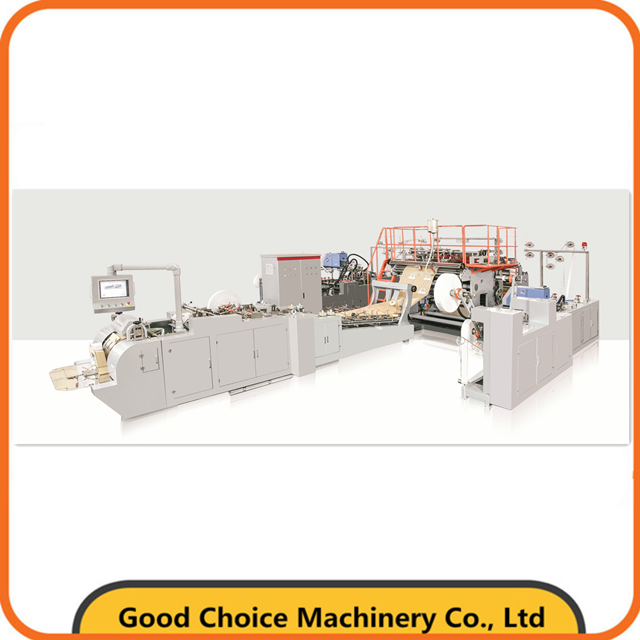
Many modern configurations integrate flexo-printing units and handle-making modules directly into the workflow. The machine folds twisted paper cords or flat paper loops and pastes them inside the bag before final closure.
While convenient, you must understand the implementation reality. Inline additions increase the total machine footprint. They consume significantly more power. They also multiply setup complexity. A jam in the handle-pasting unit stops the entire bag-making process. Ensure your production models account for these operational variables.
Procurement teams often fixate on top-end speed. This approach frequently leads to poor purchasing decisions. You must utilize a more holistic evaluation framework.
Don't just look at advertised "bags per minute." A machine running at 300 bags per minute is useless if it jams every half hour. Evaluate your actual "yield per shift." You must factor in average downtime for paper roll changes. Account for time spent topping up glue tanks. Real-world yield heavily depends on machine stability, not just theoretical speed.
Evaluation Area | Common Specification | True Operational Metric |
|---|---|---|
Production Speed | Maximum Bags Per Minute (BPM) | Net Yield Per 8-Hour Shift (accounting for jams) |
Material Handling | Acceptable GSM Range | Waste percentage on heaviest and lightest approved papers |
Agility | Supported Bag Dimensions | Documented tool-changeover time in minutes |
Verify the machine's acceptable GSM (grams per square meter) range. Paper behaves differently at varying thicknesses. A machine configured to handle lightweight 60gsm pharmacy bags perfectly might struggle with 150gsm premium kraft paper. Thick paper tends to crack during bottom folding if the scoring wheels lack sufficient pressure adjustments.
Assess the minimum and maximum bag dimensions. Compare these limits against your current product catalog. More importantly, map them against your future sales strategy. A highly restrictive dimension range limits your ability to win new client contracts.
Bag manufacturers rarely run a single size endlessly. You will switch between small retail bags and large grocery sacks. Perform the skeptical check here. Ask vendors for realistic, documented changeover times between different bag sizes.
Older machines require operators to manually swap heavy metal tooling blocks. This takes hours. Modern machines use servo motors to adjust width and length via the touchscreen. Lengthy mechanical tooling changes can entirely destroy the profitability of short-run orders.
Industrial machinery poses inherent risks. Ensure the machinery meets regional safety standards, such as CE or UL certifications. The machine must feature highly visible, easily accessible emergency stops across all operating zones.
Consider the operational environment. High-speed paper bag machines generate significant noise. Look for machines that include acoustic enclosures. If noise decibels exceed your facility limits, you face regulatory fines and a poor working environment.
Successful deployment requires preparation far before the machinery arrives at your loading dock. Mitigating risks early ensures a smooth installation phase.
You cannot simply plug industrial equipment into standard outlets. Assess the following facility requirements:
Power supply stability: Verify your facility meets the specific three-phase voltage requirements. Voltage drops during operation cause servo motors to lose synchronization.
Floor load-bearing capacity: These machines weigh several tons. Verify your concrete slab can support the weight. Implement heavy-duty vibration dampening pads to prevent mechanical shifting over time.
Air compressor requirements: Tension brakes and pneumatic cylinders require a massive, steady flow of clean, dry air. Undersized air compressors lead to sluggish mechanical timing.
Never accept shipment without rigorous testing. Demand a Factory Acceptance Testing (FAT) protocol. Crucially, you must use your specific paper grades and your chosen glue during this test. Running premium vendor paper during a test hides machine flaws that will appear when you use standard-grade kraft paper.
Evaluate the vendor's Service Level Agreement (SLA). Machine downtime burns cash rapidly. Investigate their spare parts availability. Ensure they offer remote diagnostic support, allowing their engineers to log into your PLC to troubleshoot software faults instantly.
Begin by auditing your current production bottlenecks. Identify whether your constraint is labor availability, mechanical downtime, or slow changeovers. Once identified, request detailed technical specifications from your shortlisted vendors. Focus your discussions entirely on how their machinery resolves your specific bottlenecks.
Understanding how a paper bag machine works serves as the foundation for making a secure, profitable capital equipment purchase. You must view these machines not as simple folders, but as complex, synchronized automation cells. By mastering the core mechanics—from web tensioning to bottom folding—you protect your investment. Successful deployment ultimately relies on matching the machine’s specific technical mechanics to your distinct business constraints. Assess the required automation level. Evaluate component quality and changeover agility. Align these factors with your market demands and labor availability.
To achieve optimal manufacturing output and maximize long-term equipment value, choosing a dependable technology partner is a GOOD CHOICE. As an industry-leading packaging machinery pioneer, GOOD CHOICE delivers highly robust, fully automated paper bag making systems configured to drastically lower waste, boost shift yields, and adapt seamlessly to modern sustainable market trends.
We encourage you to consult with an engineering specialist before finalizing any purchase. Request a customized production audit. This ensures you determine the exact machine configuration your facility requires for long-term operational success.
A: Depending on the level of servo-automation and whether tooling blocks need physical swapping, changeovers can take anywhere from 30 minutes on premium machines to over 2 hours on older, mechanically geared models.
A: Generally, no. The forming mechanisms for V-bottom (often used for bakery/grocery) and square-bottom (block bottom, used for retail/shopping) are fundamentally different. Buyers usually need dedicated machines for each type.
A: Routine maintenance includes daily cleaning of the gluing matrix, regular lubrication of mechanical gears/chains, and periodic calibration of web-tension sensors and cutting blades to prevent material jams.
A: Machines are calibrated for specific paper types (typically kraft paper) and a specific GSM range. Running paper outside the specified thickness or tensile strength will lead to frequent web breaks or folding failures.